

 English
  中文简体
中文简体  русский
  Español
  عربى
عربى 
Content
- 1 Define the Performance Requirements Before Selecting Any Fabric
- 2 Fiber Type: The Foundation of Mesh Fabric Performance
- 3 Mesh Structure and Knit Construction: Matching the Build to the Body Zone
- 4 Fabric Weight: Balancing Coverage, Breathability, and Durability
- 5 Moisture Management: Wicking, Drying Rate, and Fabric Finish
- 6 Sport-Specific Mesh Selection Guide
- 7 Functional Finishes That Enhance Mesh Fabric Performance
- 8 Key Tests and Standards to Verify Before Specifying Sportswear Mesh
Choosing the right mesh fabric for sportswear requires matching fiber type, knit structure, weight, stretch recovery, and moisture management properties to the specific demands of the sport and the garment's role. A fabric that performs perfectly in a running singlet will fail in a compression sleeve or a team jersey. The right choice starts with defining the performance requirements — not the aesthetic ones — and working backward to the fabric specification.
Define the Performance Requirements Before Selecting Any Fabric
Before evaluating any mesh fabric, establish exactly what the garment must do. Sportswear mesh fails most often not because of poor materials, but because the specification was too vague at the outset. The following questions should be answered before any fabric is shortlisted:
- What sport or activity is it designed for? High-impact sports like rugby or basketball demand tear resistance and durability; endurance sports like running or cycling prioritize lightweight and moisture transport.
- What part of the garment will it be used in? A mesh panel in an underarm ventilation zone has different requirements than a full-body mesh jersey or a compression base layer.
- What environmental conditions will the athlete face? Outdoor cold-weather sports require wind resistance; indoor court sports prioritize maximum airflow; water sports demand fast-drying properties.
- What is the expected wash and wear cycle? Team kits washed 100+ times per season need colorfastness and dimensional stability that a single-use race garment does not.
Fiber Type: The Foundation of Mesh Fabric Performance
The fiber content of a mesh fabric determines its moisture behavior, durability, stretch character, and care requirements. In sportswear, synthetic fibers dominate for performance reasons, but each has distinct trade-offs.
Polyester
Polyester is the dominant fiber in performance sportswear mesh, accounting for the majority of team jerseys, running shirts, and training apparel worldwide. Its advantages are substantial: low moisture absorption (0.4% by weight), meaning it does not hold sweat against the skin; excellent UV resistance; strong colorfastness under repeated washing; and high tensile strength relative to its weight. Recycled polyester (rPET), made from post-consumer plastic bottles, now matches virgin polyester in performance and is increasingly specified by major sportswear brands for sustainability commitments.
The limitation of polyester is odor retention — the hydrophobic fiber surface allows bacteria to colonize more readily than natural fibers. This is addressed with antimicrobial finishes (silver ion or zinc pyrithione treatments) in premium performance mesh.
Nylon (Polyamide)
Nylon mesh offers superior abrasion resistance compared to polyester — a critical advantage in sports involving sliding, contact with equipment, or frequent friction. Nylon 6,6 has an abrasion resistance approximately 10 times higher than standard polyester in standardized Martindale testing. It is also softer against the skin and has slightly better moisture absorption (~4%), which some athletes prefer for comfort. The trade-offs are higher cost, slightly lower UV resistance, and greater susceptibility to color fading compared to polyester. Nylon mesh is commonly chosen for cycling shorts liners, wrestling singlets, and compression garments where skin contact and abrasion are constant concerns.
Elastane / Spandex Blends
Pure polyester or nylon mesh has limited stretch. Adding 5–20% elastane (spandex/Lycra) transforms the fabric's stretch and recovery behavior dramatically. Elastane can elongate up to 500–600% before returning to its original dimensions without permanent deformation. In mesh fabrics, even a 5% elastane content delivers four-way stretch and a close body fit that holds its shape through repeated movement cycles. Higher elastane content (15–20%) is used in compression mesh, where the fabric must exert consistent graduated pressure on the muscle. However, elastane degrades with chlorine exposure, so swimwear mesh blends use chlorine-resistant variants (such as LYCRA SPORT HyFit).
Merino Wool and Natural Fiber Mesh
Merino wool mesh is a niche but growing category in endurance and outdoor sports. Its natural crimp creates an inherently open structure, and its moisture-wicking mechanism — absorbing vapor into the fiber core rather than moving liquid across the surface — provides excellent temperature regulation in variable conditions. Merino can absorb up to 35% of its weight in moisture without feeling wet, a property no synthetic fiber matches. It is also naturally odor-resistant without chemical treatments. The limitations are higher cost, lower abrasion resistance, and a requirement for more careful laundering.
| Fiber | Moisture Absorption | Abrasion Resistance | Stretch (without elastane) | Best For |
|---|---|---|---|---|
| Polyester | 0.4% | Good | Low | Team jerseys, training apparel |
| Nylon | ~4% | Excellent | Low–Moderate | Compression, cycling, contact sports |
| Polyester + Elastane | Low | Good | Very High | Fitted jerseys, compression panels |
| Nylon + Elastane | Moderate | Excellent | Very High | Swimwear, yoga, high-friction zones |
| Merino Wool | Up to 35% | Low | Low–Moderate | Trail running, hiking, cold-weather |
Mesh Structure and Knit Construction: Matching the Build to the Body Zone
In sportswear, the knit structure of the mesh — not just the fiber — determines how the fabric interacts with the body during movement. The same polyester yarn knitted in different constructions produces fabrics with radically different hand feel, breathability, and mechanical behavior.
Bird's Eye Mesh
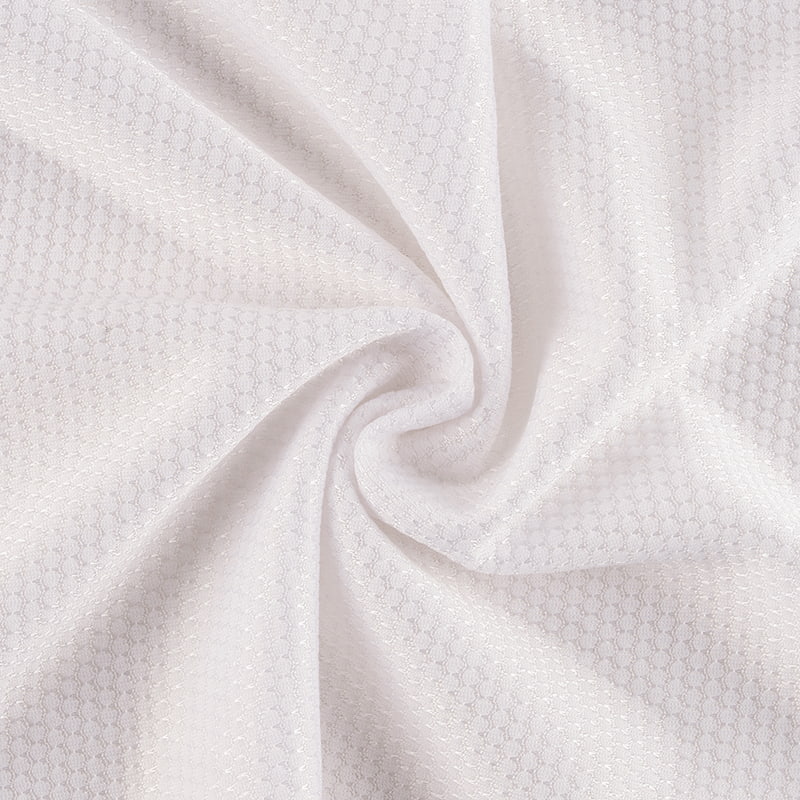
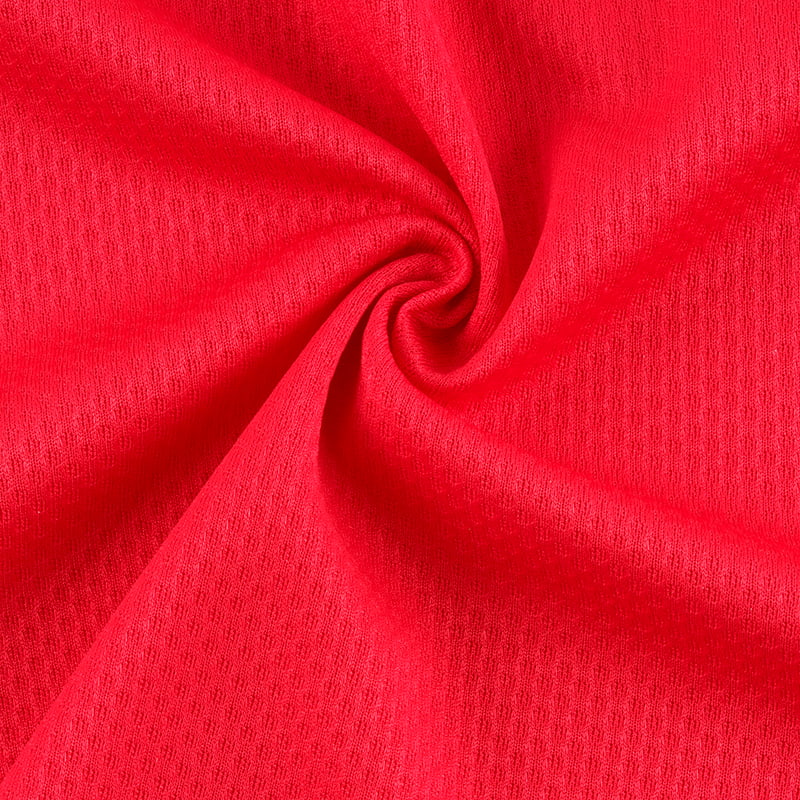
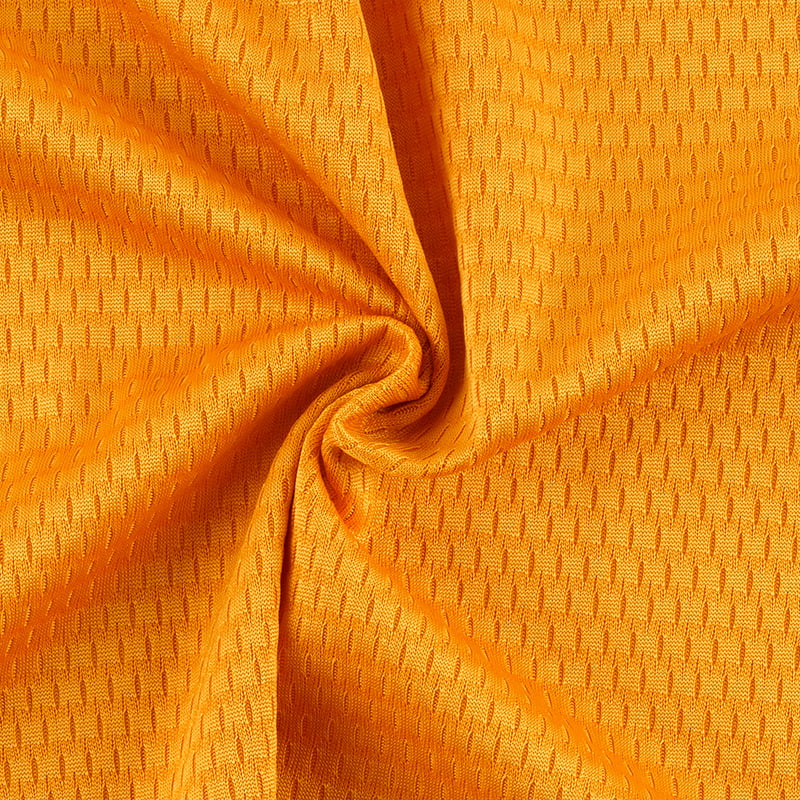
Bird's eye mesh is a double-knit construction with small, uniform hexagonal or diamond-shaped pores. It is the standard for team sport jerseys — basketball, football, soccer, and rugby — because it balances open area (typically 30–45%) with structural integrity. The double-knit construction resists snagging and tearing better than single-knit alternatives, making it durable enough for contact sports. It accepts sublimation printing without the dye bleeding into open areas, which is essential for team uniform customization.
Eyelet Mesh
Eyelet mesh features larger, more widely spaced openings — typically 3–8 mm in diameter — in a regular grid pattern. It provides maximum airflow and is used in ventilation panels on running singlets, cycling jerseys, and training tops. The larger apertures mean lower fabric coverage and reduced structural strength, so eyelet mesh is rarely used as the primary fabric for a full garment — it is most effective as a strategic panel in high-sweat zones such as the underarm, upper back, or side panels.
Spacer Mesh
Spacer mesh is a three-dimensional knit construction with two separate surface layers connected by vertical monofilament strands, creating a fabric that is typically 2–10 mm thick. The interior air gap provides cushioning, thermal insulation, and continuous ventilation through the fabric body. In sportswear, spacer mesh is used in helmet liners, shoe uppers, back panels of hydration packs, and padded protective garments. Its compressibility and recovery make it an effective substitute for foam padding in applications where breathability is also required.
Warp-Knit Technical Mesh
Warp-knit mesh — produced on Raschel or Tricot machines — is the construction of choice for compression garments, base layers, and performance tights. The warp-knit structure locks loops in both directions simultaneously, providing four-way stretch with excellent recovery and minimal laddering risk. When combined with elastane, warp-knit mesh can deliver graduated compression profiles (e.g., 15–20 mmHg at the ankle tapering to 8–12 mmHg at the calf) that are used in recovery garments and sports medicine applications.
Fabric Weight: Balancing Coverage, Breathability, and Durability
Mesh fabric weight, measured in grams per square meter (gsm), directly influences how the garment feels, performs, and wears over time. Lighter fabrics breathe better and feel less restrictive; heavier fabrics last longer and provide more coverage and opacity.
- 80–110 gsm: Ultra-lightweight mesh used in elite running singlets and race-day garments. Maximum airflow, minimum weight — but lower durability and often semi-transparent. Suited for single-sport competition use rather than daily training.
- 120–160 gsm: The standard range for most performance sportswear jerseys and training tops. Balances breathability with adequate opacity, print quality, and wash durability. The majority of team jerseys fall in the 130–150 gsm range.
- 170–220 gsm: Heavier mesh used in outerwear panels, protective garments, and applications where durability and coverage outweigh lightweight performance. Also common in mesh used as a lining layer inside jackets or shorts.
- Above 220 gsm: Structural or padded mesh, typically spacer constructions. Used in protective sportswear, orthopedic supports, and equipment padding rather than primary garment fabric.
Moisture Management: Wicking, Drying Rate, and Fabric Finish
Moisture management in sportswear mesh is not just about fiber hydrophobicity — it is a system involving fabric structure, yarn geometry, and surface treatments working together. Two key metrics define moisture performance:
Wicking Rate
Wicking is the capillary transport of liquid moisture from the skin surface through and across the fabric to its outer face, where it can evaporate. In mesh fabrics, the open structure reduces the fabric-to-skin contact area, which lowers the rate at which sweat transfers to the fabric. This is why mesh outperforms solid knit fabrics in keeping the skin dry — less surface contact means less sweat accumulation at the skin interface. Fabrics treated with a hydrophilic finish on the inner face and a hydrophobic finish on the outer face create a unidirectional moisture gradient that accelerates wicking. Premium moisture-management mesh can move sweat from the skin surface to the outer face in under 3 seconds under standardized testing (AATCC 195).
Drying Rate
Drying rate measures how quickly moisture evaporates from the fabric after saturation. Lighter-weight mesh with a higher open area dries significantly faster than heavier, tighter constructions. A 100 gsm polyester mesh may dry in 15–20 minutes at room temperature after saturation, compared to 45–60 minutes for a 180 gsm cotton jersey. For multi-activity or multi-day use — trail running, adventure racing, or travel sport — fast drying rate reduces chafing risk and bacterial growth during extended wear.
Sport-Specific Mesh Selection Guide
| Sport / Use Case | Recommended Mesh Type | Fiber Recommendation | Weight Range | Priority Properties |
|---|---|---|---|---|
| Basketball / Football | Bird's eye mesh | 100% polyester | 130–150 gsm | Durability, print quality, airflow |
| Running (competition) | Eyelet or fine-gauge mesh | Polyester or nylon | 80–110 gsm | Minimum weight, maximum airflow |
| Cycling | Warp-knit technical mesh | Nylon + elastane | 120–160 gsm | Four-way stretch, abrasion resistance |
| Yoga / Pilates | Warp-knit compression mesh | Nylon + elastane | 150–180 gsm | Softness, opacity, stretch recovery |
| Trail Running / Hiking | Fine-gauge knit mesh | Merino wool or polyester | 120–160 gsm | Odor resistance, temperature regulation |
| Swimming / Water Sports | Warp-knit chlorine-resistant | Nylon + chlorine-resistant elastane | 170–220 gsm | Chlorine resistance, shape retention |
| Protective / Padding | Spacer mesh | Polyester monofilament | 200–400 gsm | Cushioning, ventilation, recovery |
Functional Finishes That Enhance Mesh Fabric Performance
Beyond fiber and structure, chemical and mechanical finishes applied to mesh fabric can significantly extend its functional range. The most relevant finishes for sportswear applications include:
- Antimicrobial treatment: Silver ion (Ag+) or zinc-based treatments inhibit bacterial growth on the fabric surface, reducing odor in high-sweat applications. Look for finishes tested to ISO 20743 and confirmed to last at least 50 wash cycles before significant reduction in efficacy.
- Durable water repellency (DWR): A fluorocarbon-free DWR coating causes water to bead and roll off the fabric surface rather than saturating it, maintaining breathability in light rain. Essential for outdoor running and cycling mesh in variable weather. DWR must be reactivated periodically by tumble drying or ironing after washing.
- UV protection finish: Mesh fabrics by nature have a lower UPF rating than solid fabrics due to their open structure. A UV-absorbing finish can bring a standard UPF 15–20 mesh up to a UPF 50+ rating, which is essential for outdoor endurance sports with long sun exposure.
- Anti-snag finish: Applied to warp-knit and eyelet mesh used in sports involving contact with rough surfaces (climbing, obstacle racing), anti-snag treatments lubricate the yarn surface to reduce the likelihood of loops catching and pulling.
Key Tests and Standards to Verify Before Specifying Sportswear Mesh
When sourcing mesh fabric for sportswear — especially for team kits or branded performance lines — always request test data against recognized standards before committing to a fabric. The following tests are most relevant:
- Pilling resistance (ISO 12945-2 / ASTM D3512): Mesh fabrics with fine-gauge yarns or loose loop structures are prone to surface pilling with abrasion. A rating of 4–5 out of 5 after 2,000 Martindale cycles is acceptable for performance apparel.
- Colorfastness to washing (ISO 105-C06): Team jerseys washed frequently should achieve a rating of 4 or above for color change and staining to avoid visible fading within a season.
- Bursting strength (ISO 13938-1): For full-body mesh garments in contact sports, a minimum bursting strength of 250 kPa ensures the fabric will not rupture under the stresses of tackles, falls, or rapid directional changes.
- Dimensional stability after washing (ISO 5077): Mesh fabrics should not shrink more than 3–5% in either direction after repeated laundering to maintain consistent fit across the garment's service life.
- Moisture management (AATCC 195 / ISO 9073-6): Request wicking rate, spreading speed, and overall moisture management capacity (OMMC) scores to objectively compare fabrics rather than relying on marketing claims.